Every time you check the weather on your phone, pay for something with PayPal, or ask ChatGPT a question, an API is working behind the scenes. It is one of the most important ideas in modern software — yet most people have no idea what it actually means.
The term sounds technical, but the concept is surprisingly simple. In fact, you already use APIs every day without realizing it. In this beginner-friendly guide, we will explain what an API is, how it works, and why it matters — all in plain English with real examples.
API stands for Application Programming Interface. That is a mouthful, so let's break it down:
In simple terms, an API is a messenger that allows one piece of software to talk to another. It takes a request from one app, delivers it to another, and brings back the answer.
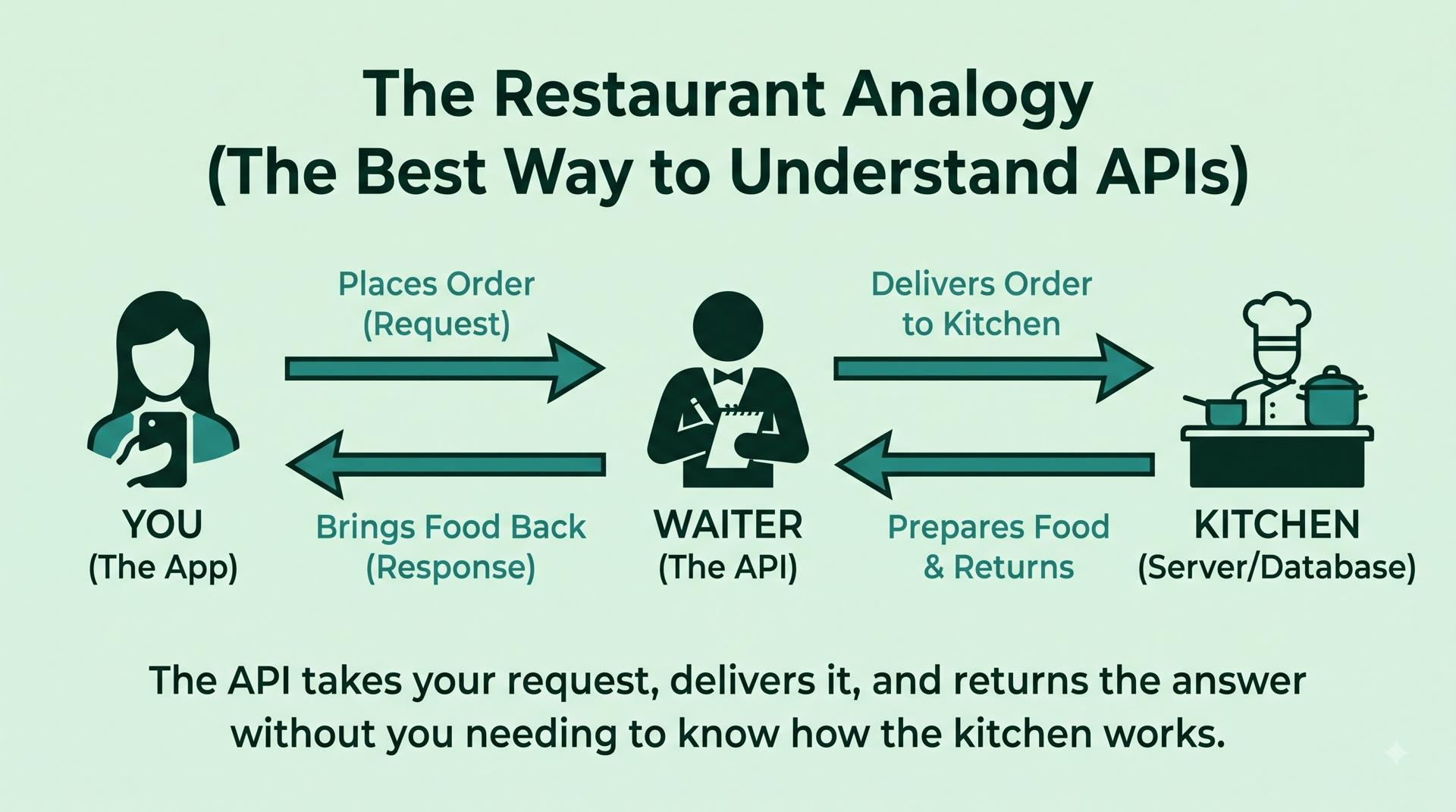
Imagine you walk into a restaurant. You sit at a table and look at the menu. You do not walk into the kitchen, grab ingredients, and cook your own meal. Instead, you tell the waiterwhat you want. The waiter goes to the kitchen, gives your order to the chef, and brings back your food.
In this analogy:
You never need to know how the kitchen works. You just tell the waiter what you want, and the waiter brings it back. That is exactly what an API does — it takes your request, delivers it to the right place, and returns the answer.
Every API follows the same basic flow: a request goes out, the server processes it, and a response comes back. Here is the process in four simple steps.
Your app asks the API for something. For example, a weather app asks: "What is the temperature in Mumbai right now?"
The API takes that request and delivers it to the server that holds the weather data. The API knows exactly where to send it and how to ask.
The server processes the request and sends back the answer — usually in a format called JSON, which is just structured text that machines can read easily.
The API delivers the answer back to your app. The app reads it and displays "32°C in Mumbai" on your screen.
Let's walk through a real scenario. You open a weather app and enter your city.
| Step | What Happens |
|---|---|
| 1. You Tap | You enter "Mumbai" in the weather app |
| 2. App Calls API | App sends a request to the weather API |
| 3. API Asks Server | API delivers the request to the weather database |
| 4. Server Replies | Server sends back JSON: {"temp": 32, "condition": "sunny"} |
| 5. App Shows It | You see "32°C, Sunny" on your screen |
All of this happens in under a second — often without you noticing. That is the power of APIs.
Both use the same internet, but they serve different purposes.
| Aspect | Website | API |
|---|---|---|
| Who Uses It | Humans (you and me) | Software (apps, programs) |
| What It Returns | Web pages, images, buttons | Raw data (usually JSON) |
| Example | You open weather.com in a browser | Your weather app pulls data from the weather API |
Think of it this way: a website is for humans to read. An API is for machines to talk.
There are several types of APIs, but you only need to know a few common ones to start.
The most popular type. REST APIs use standard web requests (GET, POST, PUT, DELETE) to fetch or change data. When people say "API," they usually mean REST.
A newer type that lets the client ask for exactly the data it needs — no more, no less. Popular with modern apps like Facebook and GitHub.
Used for real-time communication. Keeps a constant connection open so data can flow instantly — used in chat apps, live sports scores, and stock tickers.
APIs are the invisible glue that holds the modern internet together. Once you understand the restaurant analogy, everything else falls into place.