You hear the term "Machine Learning" everywhere today — in news headlines, job listings, and every AI product on the market. But what does it actually mean? Is it the same as AI? Do you need to be a mathematician to understand it?
The good news: Machine Learning is much simpler than it sounds. In fact, you already use it every day — when Netflix recommends a movie, when Gmail filters spam, when your bank flags a suspicious transaction. None of these were explicitly programmed. The machine learnedhow to do them from data.
In this beginner-friendly guide, we will explain what Machine Learning is, how it works, and the three main types — all in plain English with simple examples.
Machine Learning (ML) is a branch of Artificial Intelligence where computers learn from data instead of being explicitly programmed. In traditional programming, a human writes every rule the computer must follow. In Machine Learning, the computer figures out the rules on its own by studying examples.
Imagine you want to build a program that detects spam emails.
That is the core idea: instead of writing rules, you provide examples, and the machine learns the rules itself.
These three terms are often used interchangeably, but they are not the same. Think of them as nested circles:
| Term | What It Means | Example |
|---|---|---|
| Artificial Intelligence (AI) | The broad goal of making machines smart | Any system that mimics human intelligence |
| Machine Learning (ML) | A subset of AI where machines learn from data | Spam filters, recommendation engines |
| Deep Learning (DL) | A subset of ML using large neural networks | ChatGPT, image recognition, self-driving cars |
So: AI is the goal, Machine Learning is a method, and Deep Learning is a powerful technique inside ML. Every Deep Learning system is Machine Learning, but not every Machine Learning system uses Deep Learning.
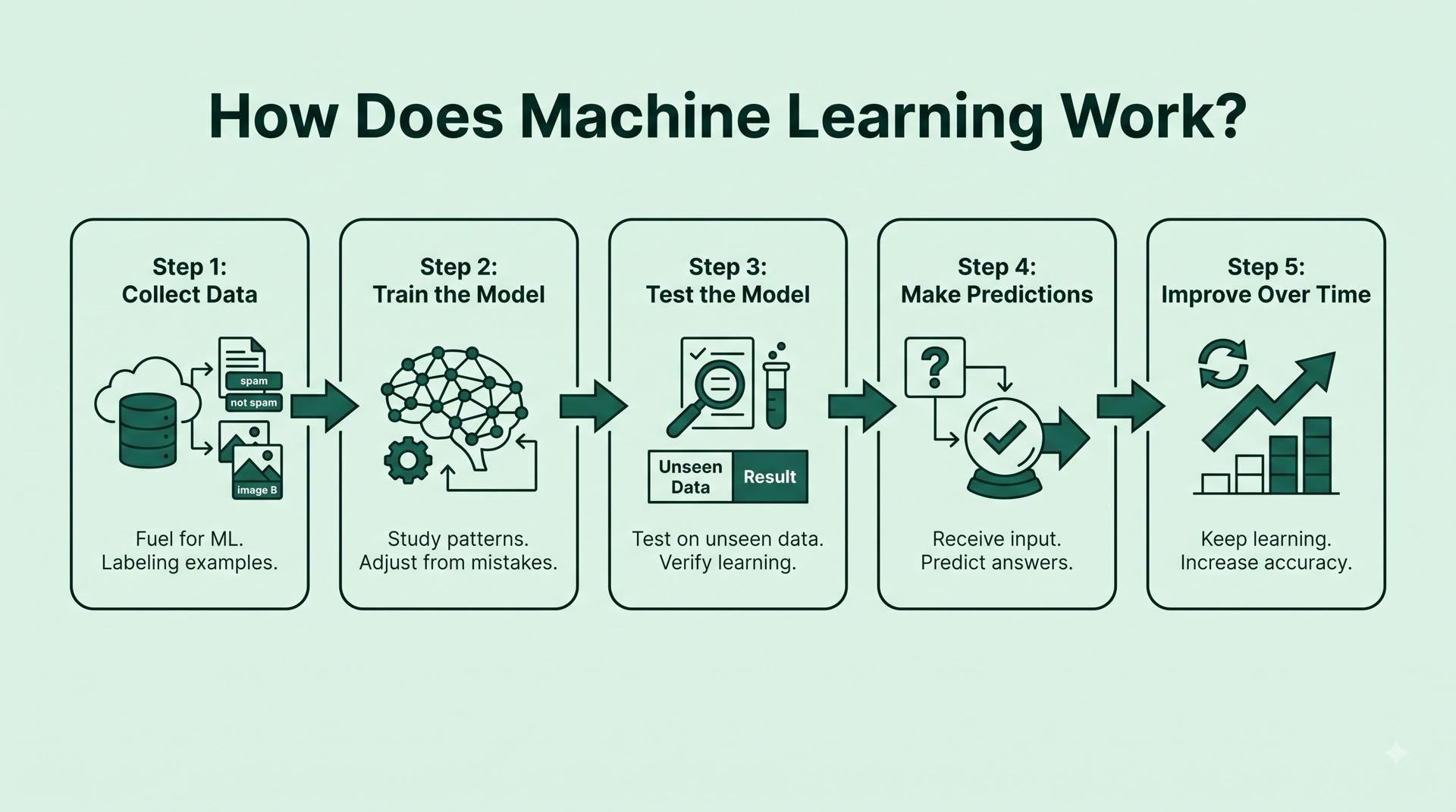
At its heart, Machine Learning follows a simple loop: feed data in, let the model find patterns, test it, and improve it. Here is the process in five steps.
Data is the fuel of Machine Learning. The more examples the machine sees, the better it learns. For a spam filter, this means thousands of emails labeled "spam" or "not spam."
The algorithm studies the data and looks for patterns. It adjusts itself every time it makes a mistake — just like a student learning from corrected homework.
Once trained, the model is tested on data it has never seen before. This proves whether it actually learned — or just memorized the training examples.
The model is now ready to be used. It receives new input (a fresh email, a new image) and predicts the answer.
Good ML systems keep learning. Every new piece of data helps the model become more accurate.
Machine Learning comes in three main flavors, each suited for different kinds of problems. Here is the simplest way to think about them.
You give the machine labeled examples — input and correct output — and it learns to predict the output for new inputs.
You give the machine data without labels. It finds hidden patterns and groups on its own.
The machine learns by trial and error, receiving rewards for good actions and penalties for bad ones.
Let's walk through how Machine Learning works using a simple example: teaching a computer to recognize cats in photos.
| Step | What Happens |
|---|---|
| 1. Collect Data | Feed the model 10,000 photos labeled "cat" or "not cat" |
| 2. Find Patterns | Model notices cats have pointed ears, whiskers, and fur |
| 3. Test | Show 1,000 new photos. Model guesses "cat" or "not cat" |
| 4. Improve | Fix mistakes and re-train until accuracy reaches 95%+ |
| 5. Deploy | Now the model can recognize cats in any new photo |
That is Machine Learning in action — no human ever wrote a rule like "a cat has whiskers." The model discovered that on its own by studying thousands of examples.
Machine Learning is not magic — it is pattern recognition at scale. Once you understand the basics, the entire world of AI becomes much easier to grasp.